
Flexible packaging plays an important role in protecting products across many industries. Food, healthcare, personal care and industrial products all rely on packaging that maintains product quality during storage and transportation. For many years, conventional flexible packaging used laminated structures made from different materials to provide strong barrier protection against oxygen, moisture and light.
Recyclable flexible packaging has become a sustainable alternative to conventional laminated materials. Unlike traditional packaging, recyclable structures are designed using mono material films. These structures may include multiple layers but all layers are made from the same material type. This design allows the packaging to be processed efficiently in recycling systems while maintaining performance. As companies place greater focus on sustainability, recyclable flexible packaging is becoming a practical solution for industries that require strong product protection and environmental responsibility.
In this article, we will explain how advances in film technology are enhancing barrier performance in recyclable packaging. We will also discuss the differences between conventional and recyclable structures, describe the role of mono material films, highlight new high-barrier technologies, and show how modern innovations enable recyclable packaging to meet the performance requirements of various industries.
Barrier performance is the ability of packaging materials to block gases, moisture and other external elements from entering or leaving the package. Strong barrier protection is important because many products are sensitive to oxygen, humidity or environmental exposure. Without proper barrier protection, product quality can decline quickly.
In flexible packaging, barrier performance has a direct impact on shelf life and product stability. Food products can spoil if oxygen enters the package, while moisture can damage powders, snacks and pharmaceutical materials. Packaging must provide an effective protective layer that keeps the product in its intended condition.
Due to these requirements, packaging materials are carefully designed to control the movement of gases and moisture. Advances in film technology are helping recyclable structures achieve barrier performance that was previously possible only with conventional laminated materials.
For many years, conventional flexible packaging relied on laminated structures that combine different materials. These materials are selected based on their individual strengths, including mechanical durability, sealability and barrier protection.
A common conventional packaging structure uses PET laminated with PE, where PET provides strength and barrier protection, while PE offers sealing performance and flexibility. When these layers are combined, the packaging provides strong protection for many products.
In addition, the main limitation of this structure is the use of different film types. Recycling systems cannot easily separate these layers, so conventional laminated packaging is generally not recyclable. This challenge has encouraged the industry to develop recyclable alternatives.
Layer optimization is a key strategy in modern recyclable flexible packaging. By adjusting the thickness, arrangement, and composition of mono material layers, manufacturers can improve barrier performance while maintaining recyclability.
These benefits include:
Through layer optimization, recyclable packaging can meet demanding barrier requirements, ensuring that sensitive products remain safe throughout storage and distribution.
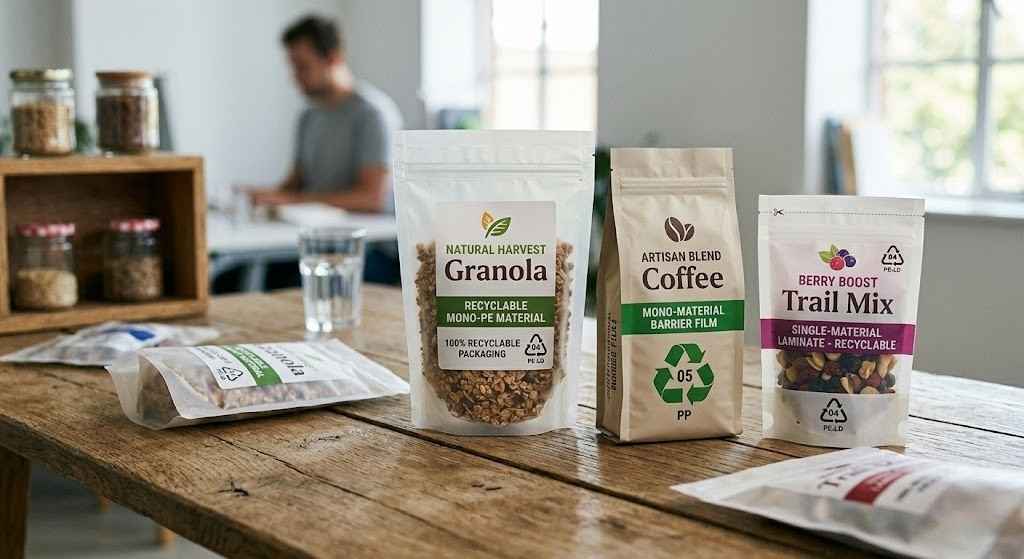
Recyclable flexible packaging is usually based on mono material structures. In these designs, the packaging is made from the same type of material throughout the entire structure.
Mono material does not mean the packaging contains only a single layer. In many cases, recyclable packaging still uses multiple layers. The difference is that all layers are made from the same material type, which allows the structure to be processed more effectively in recycling systems.
A recyclable structure may use PE laminated with PE, where all layers are polyethylene. This allows the packaging to move through recycling streams designed for PE materials. This approach helps maintain performance while improving sustainability.
Most recyclable flexible packaging structures today rely on two main material families. These materials provide the flexibility, durability and sealing properties needed for packaging applications.
The majority of recyclable structures use mono material PE. Polyethylene offers strong sealing characteristics, flexibility and compatibility with recycling systems. Due to these advantages, mono material PE accounts for more than ninety percent of recyclable flexible packaging solutions.
Mono material PP is also used in recyclable packaging, although it represents a smaller portion of the market. Polypropylene provides good heat resistance and stiffness, making it suitable for applications where these properties are important.
Multilayer coextrusion allows manufacturers to combine several layers of the same material in a single film. This process improves barrier properties while keeping all layers made of the same polymer type.
These advantages of multilayer coextrusion include:
By using multilayer coextrusion, recyclable packaging can meet performance standards previously achievable only with conventional laminated films while remaining fully recyclable.
Early recyclable packaging structures faced challenges in achieving strong barrier protection. Conventional laminated packaging could combine materials with excellent barrier properties, while mono material structures had fewer options available.
Conventional packaging could combine materials such as PET, aluminum or others to achieve very high barrier protection. These materials are highly effective at preventing oxygen and moisture from passing through the packaging. Which means it can laminated to a different material film layer which is specifically for barrier function.
Mono material PE structures, on the other hand, traditionally offered lower barrier performance. This limitation made it difficult for recyclable packaging to replace conventional laminated structures in certain applications. We will have to do the barrier function on PE film. So we will either have to coated a barrier layer on the PE film, or add barrier additive on the PE film. This makes it difficult.
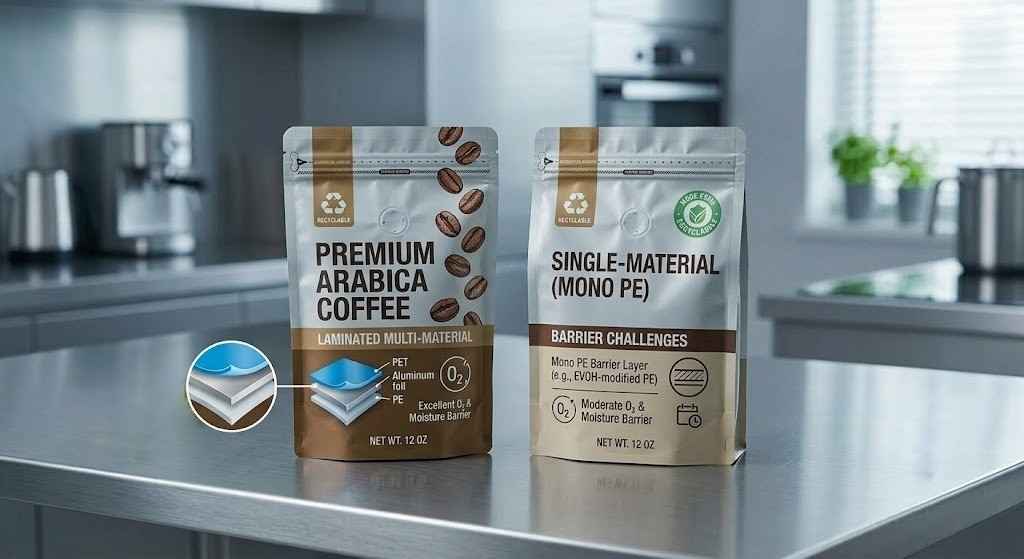
Recyclable barrier technologies provide strong protection while maintaining a mono material design. The table below summarizes the main types, their benefits and practical applications.
Technology | Function | Benefits | Recyclability | Practical Use Cases |
PE + EVOH additive | Oxygen barrier, moisture barrier. | Extends shelf life and maintains freshness | Mono material PE and fully recyclable | Gourmet foods and pharmaceuticals |
Metallized PE film | Oxygen, moisture and light barrier | High protection and long-term storage | Mono material PE and fully recyclable | Snack foods and frozen meals |
AlOx coated PE | Oxygen and moisture barrier | Transparent, lightweight and strong | Mono material PE with AlOx coating and fully recyclable | Beverages, cosmetics and medical products |
PVOH coated PE | Gas and moisture resistance | Durable, protective and reliable | Mono material PE with PVOH coating, designed to be recyclable | Specialty foods and industrial powders |
These technologies ensure that recyclable packaging provides high barrier performance while remaining fully recyclable and sustainable.
Recyclable packaging has benefited from innovations in film technology that bring its barrier performance much closer to conventional structures. Advances in material science and coating technologies have made significant progress in recent years.
New barrier enhancement methods enable mono material films to block oxygen and moisture more effectively. These improvements allow recyclable packaging to meet the performance requirements of many product categories.
As a result, recyclable flexible packaging can now satisfy the barrier needs of most industries. In many cases, modern recyclable structures can meet nearly ninety-nine percent of barrier requirements.
One important development in recyclable packaging is the use of PE combined with EVOH additive technology. EVOH is known for its strong oxygen barrier properties and is widely used to enhance packaging performance.
When EVOH is incorporated within polyethylene structures, it reduces oxygen transmission while keeping the overall structure compatible with recycling systems. This combination allows manufacturers to improve barrier protection without using completely different materials.
This technology has become an effective way to enhance the performance of mono material packaging. It helps maintain product freshness and extend shelf life while supporting a recyclable design.
Surface treatments are applied to mono material films to improve barrier performance. These treatments enhance adhesion, printability and gas resistance without affecting the recyclability of the package.
These common surface treatment approaches include:
These methods enable recyclable PE or PP films to maintain barrier integrity while keeping the package sustainable and fully mono material.
Metallized PE film is another technology that enhances barrier performance in recyclable packaging structures. In this process, a very thin metal layer is applied to the film surface to improve protection against oxygen, moisture and light.
The metallized layer acts as an additional protective barrier, reducing the transmission of gases and water vapor through the packaging film. This improvement allows mono material PE packaging to provide stronger product protection.
In addition, metallized PE films are increasingly used in packaging applications that require extended shelf life and environmental protection. When designed properly, these films support both performance and recyclability.
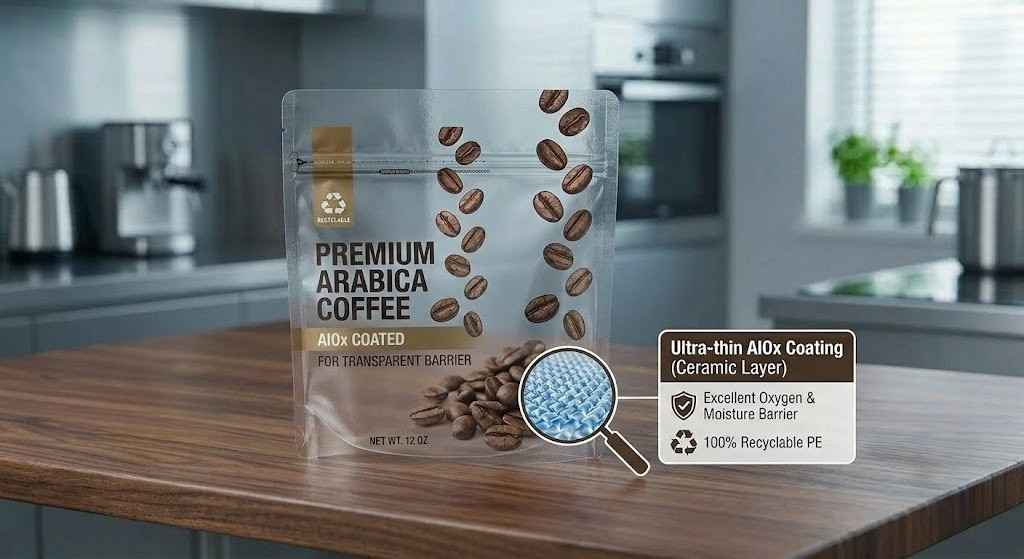
AlOx coated PE film is another advanced solution used to enhance barrier performance in recyclable flexible packaging. In this technology, a thin layer of aluminum oxide is applied to the film surface.
This coating creates an effective barrier against oxygen and moisture without significantly affecting the flexibility of the film. It helps maintain the lightweight characteristics of flexible packaging while improving protection.
In addition, AlOx technology is particularly useful for applications where transparency is required. The coating provides strong barrier protection while keeping a clear appearance, which is valuable for consumer packaging.
The future of recyclable flexible packaging focuses on improving barrier performance, reducing material use and enhancing sustainability.
Innovations include:
These trends show that recyclable packaging will continue to replace conventional laminated films in many applications, providing both sustainability and high barrier performance.
PVOH coated PE film is also used in certain barrier enhancement applications. In this method, a protective coating is applied to polyethylene films to improve resistance against environmental exposure.
The coating helps reduce the movement of gases and moisture through the film structure. This added protection supports better product stability and storage performance.
As technology continues to evolve, coated PE films are helping recyclable packaging achieve improved barrier performance while maintaining the advantages of a mono material design.
Advanced printing and lamination methods enable recyclable packaging to achieve high barrier performance while supporting design and branding needs. Proper techniques ensure the package remains mono material and environmentally friendly.
Advantages include:
These methods allow companies to create visually appealing, high-performing recyclable packaging that meets both regulatory and marketing requirements.
Heat sealing is essential for maintaining the integrity of recyclable flexible packaging. Proper sealing prevents oxygen and moisture from entering the package, preserving product quality.
Optimized heat sealing techniques improve airtightness, increase resistance to environmental exposure, and maintain consistent barrier performance during storage and transport. With controlled temperature and pressure settings, heat sealing ensures that mono material PE or PP films provide reliable protection comparable to conventional laminated structures while remaining fully recyclable.
Recyclable barrier films are now used in industries that require both product protection and sustainability. These applications show that mono material films can replace conventional laminated packaging without compromising performance.
They are widely used in fresh foods, medical packaging, cosmetic items and specialty industrial products. Manufacturers increasingly prefer recyclable films because of their environmental benefits and improved barrier properties.
These applications demonstrate that modern recyclable films provide both protection and sustainability, aligning with global trends toward greener packaging solutions.
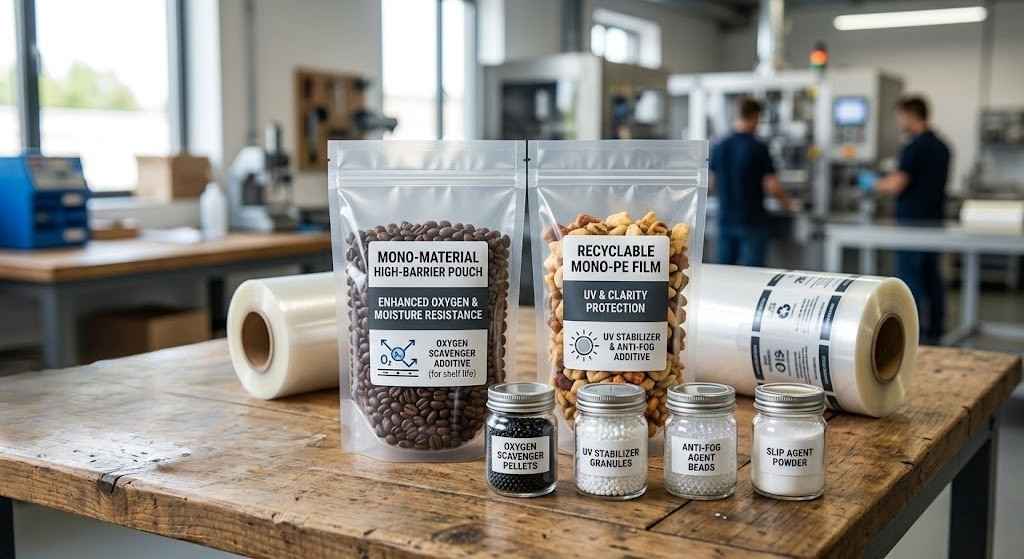
Additives are incorporated into mono material films to improve their resistance to oxygen, moisture and light. These additives enhance performance without introducing different materials that could affect recyclability.
Common additive applications include oxygen scavengers to protect sensitive products, UV stabilizers to prevent light-induced damage and anti-fog agents to maintain clarity in food packaging. Slip agents are also used to improve handling during production.
The careful use of additives ensures that recyclable packaging remains high-performing, extending product shelf life while maintaining a fully mono material structure.
Recyclable flexible packaging offers a sustainable alternative to conventional laminated packaging, which cannot be recycled because it uses different film materials. Modern mono material technologies, including PE with EVOH additives, metallized PE, AlOx coated PE, and PVOH coated PE films, have significantly improved barrier performance against oxygen, moisture, and light. Innovations such as multilayer co-extrusion, layer optimization and surface treatments now enable recyclable films to protect products effectively while supporting environmental goals. These advancements demonstrate that recyclable flexible packaging can provide both high performance and sustainability, making it the preferred choice for many industries.
Longdapac is the leading recyclable recyclable pouches supplier. Currently our high barrier recyclable packaging can meet 99% of the conventional flexible packaging needs. So we can say basically we can almost fully replace the conventional material.
Answer: Conventional packaging combines different materials, such as PET and PE, which cannot be separated by recycling systems, making it non-recyclable.
Answer: Mono material packaging uses layers made entirely of the same polymer, such as PE/PE or PP/PP, allowing it to be fully recyclable even when multiple layers are used.
Answer: EVOH reduces oxygen transmission & water transmission in PE layers without affecting recyclability, helping to extend shelf life and preserve product freshness.
Answer: Yes. The coatings are thin and applied to mono material PE layers, so they do not affect recyclability.
Answer: Yes. Advances in barrier technology and layer design enable recyclable packaging to meet the performance requirements of food, pharmaceuticals, personal care and specialty industrial products.